

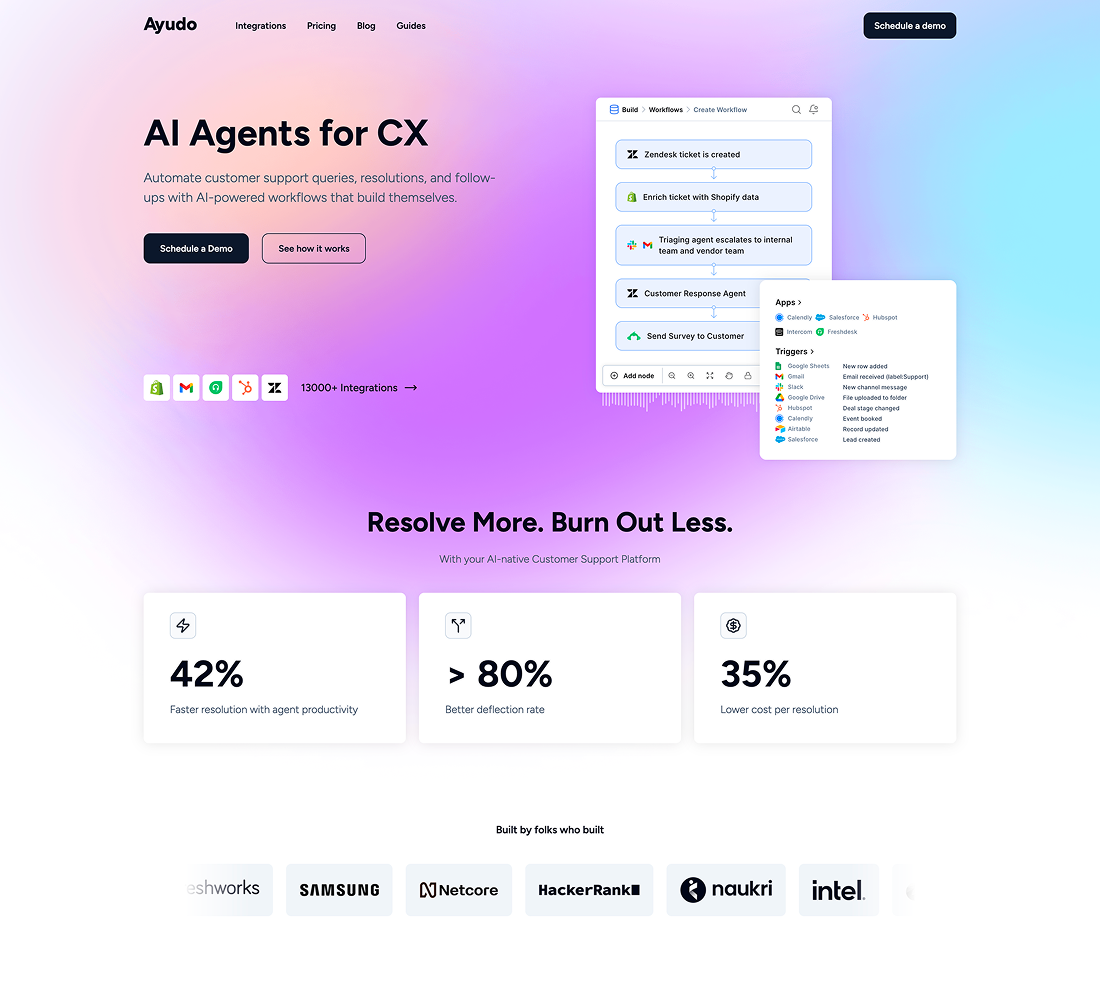

Ayudo is a customer support platform that helps teams manage and respond to user queries in one place. It’s built for businesses that want to keep support fast, simple, and easy to handle as they grow.
Ayudo joined us at the end of 2025, at a point where the product was already live and ready for users. What hadn’t yet caught up was organic search.
The site was just starting to build visibility, with only a few keywords indexed and a modest backlink profile. Most of the early focus had been on the product itself and outbound efforts, so our job was to help the right people find the platform online.
At that stage, the gap wasn’t content. It was authority. Without that, even the right pages wouldn’t move.
So we focused first on building a backlink profile that could actually support competitive rankings. We focused on getting Ayudo mentioned on sites that already have credibility in this space, including Webflow, WallStreetMojo, Dodo Payments and TechImply.
As those backlinks started coming in, pages picked up faster and held their positions better. The domain started to reach a point where it could compete for more than just long-tail queries.
That gave us a base to build on. So, once things shifted, we went straight after decision-stage searches.
Comparison and alternative pages were a big part of this. Queries like "Freshdesk alternatives," "Zendesk alternatives," and "ticketing system software" come from teams that already know the problem and are choosing between tools. Getting Ayudo into those results meant showing up at the point where the shortlist was being made.
We also focused on integration-driven searches, which behave differently. These queries are tied to implementation. Showing up here brings Ayudo closer to actual usage.
Also, we didn’t want the authority to sit on just a few pages. So we connected things properly across the site.
This way, the pages going after high-intent queries could benefit from the links coming in. And newer pages didn’t have to start from scratch. They already had some momentum behind them.
“Epic Slope brought a clear, structured approach to scaling pSEO pages while ensuring the website was built to convert—not just rank.”
Ayudo now ranks for 41 keywords, up from just 13 at the start.
On the surface, that number looks small compared to more mature sites, but the mix of keywords tells a more important story.
Out of these, 19 are commercial-intent terms. Most of these are currently sitting beyond page one. But that’s expected at this stage.
The important shift is that Ayudo is now part of these search results. Once a page is indexed and starts ranking, even in lower positions, it becomes much easier to move it up as domain authority continues to improve.
In under six months, Ayudo moved from being almost invisible in search to having:
This is the phase where SEO starts to become real. Not in terms of peak traffic yet, but in terms of direction. The groundwork is in place, and the pages that matter are already climbing.
Most of the commercial keywords are still in positions where they are not driving significant traffic yet. That changes as authority continues to build.
Pages move from page five to page two, then to page one. And when that happens for queries like "Freshdesk alternatives" or "ticketing system software," even small position gains can bring in high-value traffic.
At the same time, expanding content around similar queries increases the total surface area, making growth less dependent on a small set of pages.