Every industry has its insider language and SEO just happens to have one that sounds especially mysterious.
You’ll hear someone say, “Looks like a crawl trap.” or “That’s a link graph fracture.”
And everyone nods.
But most definitions reduce these ideas to neat one-liners. The problem is, these terms don’t mean much in theory. You only notice them when something breaks.
So this isn’t a dictionary. Just a way to make sense of them, better.
Let’s walk through the SEO terms that usually show up right before (or right after) traffic volatility.
An Issue Tree is a structured diagnostic framework used to break down a complex SEO problem into logically connected sub-issues.
Instead of asking, “Why did traffic drop?” an issue tree forces you to break the problem down.
Each branch narrows the scope until root causes are identified.
A typical issue tree looks something like this…

This is just a basic structure, it can be top down or bottom up and yes, it can have multiple branches based on the scale of your problem.
In SEO operations, issue trees prevent reactive decision-making. They are especially useful after algorithm updates, traffic volatility, or large-scale migrations. By mapping hypotheses hierarchically, you can avoid jumping to conclusions based on incomplete data.
It’s a borrowed framework from management consulting that’s now used in SEO as well.
A shibboleth is a word, phrase, or way of speaking that signals whether someone belongs to a particular group. In SEO, they refer to the terminology and language patterns that reveal a person’s level of expertise or familiarity with the field.
The term comes from the Hebrew Bible, where pronunciation was used to tell insiders from outsiders. Over time, the meaning expanded.
Today, a shibboleth can be:
In practice, shibboleths can be useful. Terms like “search intent” or “topical authority” help communicate ideas clearly and often signal real experience.
At the same time, they can become limiting when they’re outdated or repeated without context.
There are many phrases and rules in SEO that once made sense but no longer apply to how search systems work today. For instance, “keyword density must be 2 percent” is something many of us have heard early in our content careers. But search systems don’t work like rule checkers anymore.
In that sense, shibboleths in SEO can either indicate real expertise or simply repeat assumptions that no longer apply.
Pogo sticking refers to a user behavior pattern when a user clicks on a search result, quickly leaves, and jumps back to where they came from to try another option.
For instance…
It’s called “pogo sticking” because the user is bouncing back and forth, like a pogo stick.
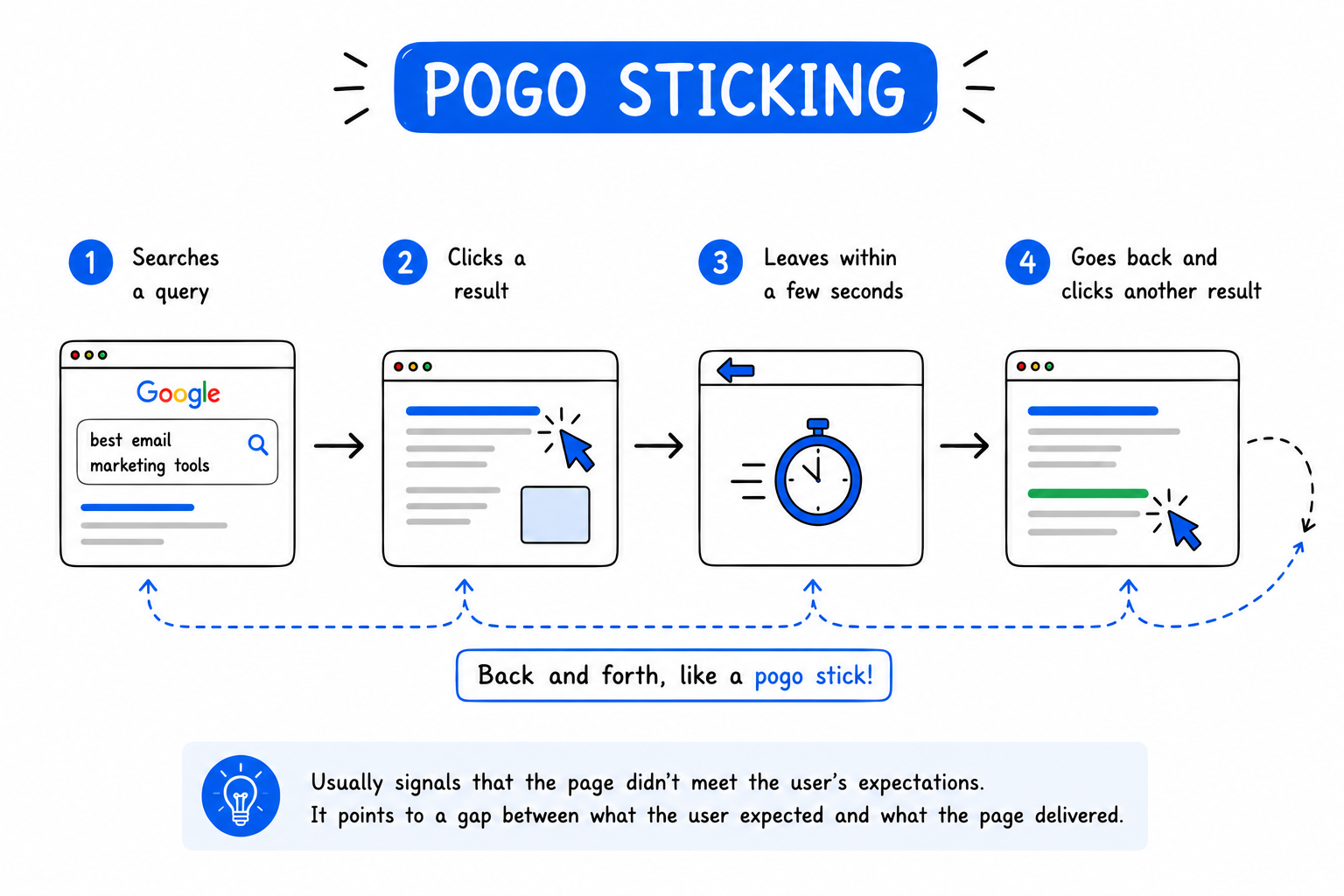
But you can’t put a finger on a single reason for it to happen. It could be because the content doesn’t match search intent, or maybe the page is hard to read or navigate or even because the answer wasn’t clear or immediate. It could also be due to misleading titles or meta descriptions that led them to the page in the first place.
So the reasons for bounce could be multiple, and can’t surely indicate the quality of the page. Which is also why Pogo Sticking isn’t considered a primary ranking factor for search systems. At the same time, it usually points to a gap between what the user expected and what the page delivered.
Note: While it sounds similar, pogo sticking should not be mistaken for bounce rate. Pogo sticking is a search behavior that happens on Google (or any search engine), while bounce rate is a website metric that tracks user interaction on a page.
A phantom redirect is when a page appears normal at first, but then redirects the user somewhere else without a clear or expected reason. It is often caused by scripts or misconfigurations.
It’s called “phantom” because the redirect isn’t obvious. It feels like it just happens in the background.
Say you click a link that says “Best CRO agencies for startups.” For a second, you see the right page. Then suddenly, you’re taken to:
You didn’t click anything. It just redirects on its own.
It confuses the users as they don't land where they expected to. And it hurts SEO as search engines may see it as inconsistent behavior.
Phantom redirects create indexing inconsistencies. Search engines may index a URL that users never see, or fail to consolidate signals correctly.
URL Shadowing occurs when multiple URLs compete for the same search intent, unintentionally cannibalizing each other’s rankings. While this is not a widely used or formal term, people use it informally for keyword cannibalization.
Unlike deliberate multi-page targeting strategies, URL shadowing is usually accidental. Sometimes your biggest competitor isn’t another domain. It’s you.
You might have:
Now say, each one is accessible and linked from somewhere. This makes them slightly different in the eyes of a crawler.
Now Google has to decide which one to rank.
Sometimes, one ranks, the other gets ignored or rankings keep switching between them, or neither performs as well as it could. This just dilutes the authority that should go to one single page.
Shadowing is not always obvious in analytics. It often appears as fluctuating rankings or unstable impressions across similar URLs.
A Crawl Trap occurs when search engine bots become stuck in an infinite or near-infinite loop of URLs, instead of moving on to important pages.
It usually happens because the site keeps generating new URLs or paths that don’t actually lead to new, valuable content. And, it wastes your crawl budget.
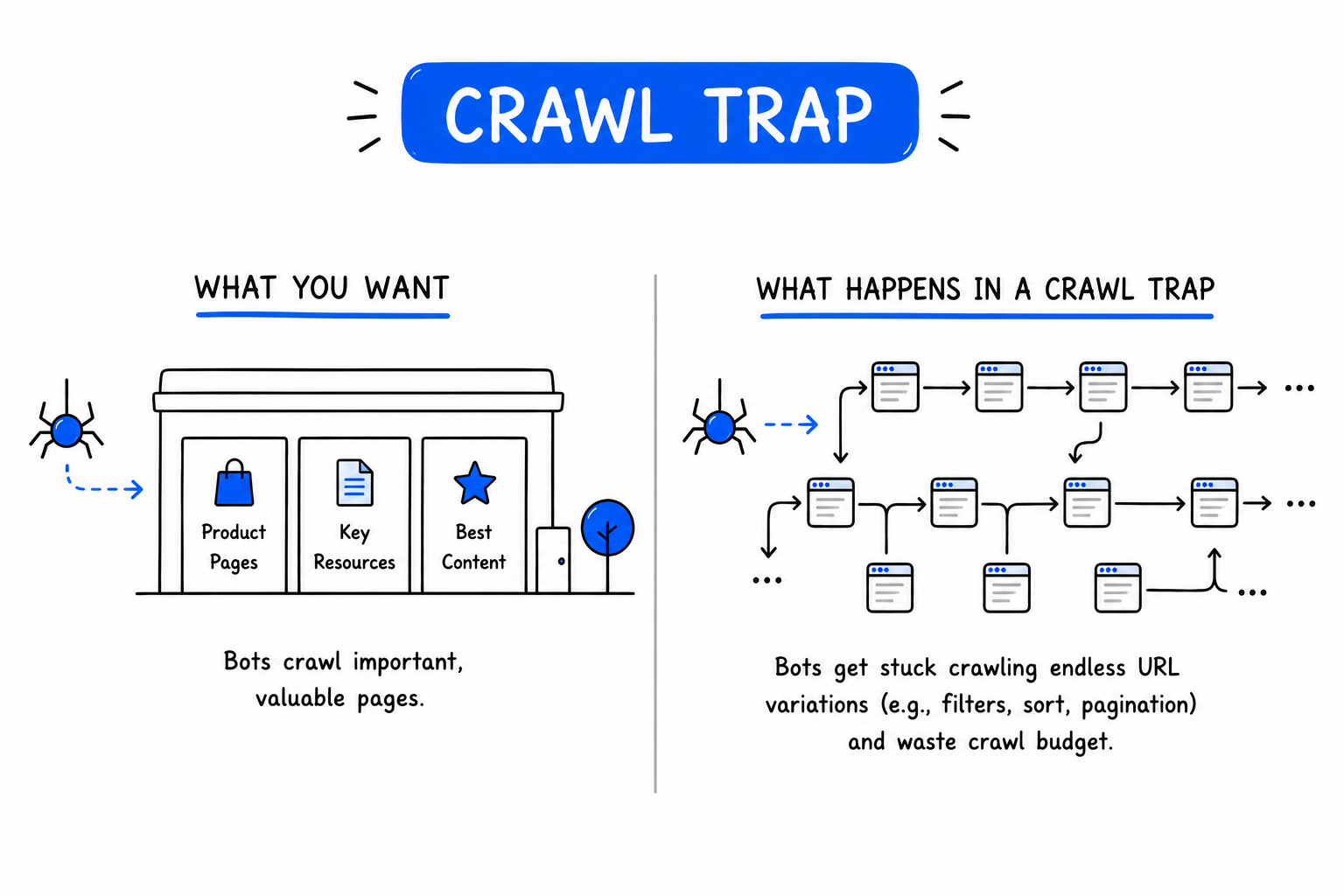
For a minute just think of your website as a building.
You want search engines to walk through the main rooms like your product pages, your key resources, your best content. Instead, they open a door and find a hallway that splits into ten more hallways. Each one opens into another ten.
If you’ve noticed, faceted filters (in e-commerce sites) often lead to this, because each combination of filters like color, size, price, sort order, and pagination creates a new URL. Multiply that across thousands of products and suddenly you’ve built an architectural maze.
Search engines treat each URL as potentially unique until proven otherwise. So they explore. And explore.
Meanwhile, your most important pages get crawled less often because bots are wandering through endless variations that offer no new value.
This is one that keeps people up at night!
Search Footprint Collapse describes a sudden reduction in the breadth of queries for which a domain ranks. It is when a website’s visibility across search queries and pages shrinks, leading to fewer rankings, reduced keyword coverage, and loss of long-tail traffic.
Pages that once brought in smaller, consistent traffic stop ranking, and impressions concentrate around a few core terms or branded searches. All the long-tail and supporting queries disappear.
It can happen for a few reasons. Sometimes content is consolidated too aggressively, or too many pages point to a single canonical version. In other cases, Google updates or thinner content can make your site appear less relevant across topics.
Recovering from this is not as easy as updating a single page or a few. You have to raise the average threshold quality across the site, restoring topical depth and strengthening internal authority signals.
Host Crowding refers to a situation where multiple pages from the same website (or domain) appear in the search engine results page (SERP) for a single query.
Back in the 2000s, Google introduced a new algorithm (or filter) for host crowding, that limited domains to two listings per query.
While there are exceptions, especially for branded searches, host crowding still influences visibility. So, today even if your site has multiple relevant pages, Google may choose to show only one or at most two of them in the first page. Again, it is not a strict rule anymore.
Understanding host crowding helps explain why ranking positions sometimes fluctuate even when you have multiple strong pages.
Link graph fracture is when a website’s internal or external links become fragmented, so authority doesn’t flow properly across the site. You can sometimes have excellent content and strong backlinks, and still struggle, because authority isn’t reaching the pages that need it.
Say you publish 50 blog posts that all link to each other, but none of them link to your core product or landing pages. Even if those blog posts attract backlinks, that value never reaches the pages that actually drive conversions.
In another case, you might have important pages that aren’t linked from anywhere on the site. These “orphan pages” are difficult for search engines to discover and rarely perform well.
This kind of fragmentation weakens your overall SEO. Some pages accumulate authority, while others just remain invisible. Over time, this creates an uneven structure where rankings depend more on isolated pockets of strength rather than a well-connected system.
Link Echoes describe the residual impact of links even after they are removed or altered.
In SEO, links don’t work like an on/off switch. While a backlink may disappear from a referring page, search engines may retain historical data about the past link relationships or the anchor text associations.
When a respected publication links to you and that article gets picked up, referenced in industry reports, or cited by analysts, the authority compounds. If that link is later removed, your rankings might hold steady for some time instead of dropping overnight. It stays for the next few weeks, or sometimes more than a few months, and then you may start to see a gradual decline. That gap between the link being removed and the impact showing up is the “echo.”
Search engines cluster duplicates, yes. But repeated legitimate references across trusted sites strengthen entity recognition and increase trust.
This is not the case for artificial echoes from scraper networks. They rarely add value.
Link echoes are a useful reminder that SEO changes often play out over time. Gains and losses don’t always show up immediately, which is why it’s important to look at trends rather than day-to-day changes.
These aren’t fixed definitions.
Most of them come from how SEO actually behaves when you work with it. People notice patterns, they try to explain them, and over time those explanations become terms. As search changes, these terms shift too.
So don’t treat them like rules. Treat them as ways to understand what you’re seeing, and build your own sense of it as you go.
Over time, things actually start to feel a lot less random. You can look at a drop, a spike, or a page that isn’t moving, and have a better idea of what might be going on.