

You’ll hear words like frameworks, models, and principles tossed around a lot in marketing. And honestly, some of them do sound like business-school jargon.
But every now and then, one of them genuinely helps.
The right framework can clear up a messy problem, help you explain an idea better, or save you from wasting time going in the wrong direction.
So rather than dismissing them or memorizing them for the sake of it, it’s worth knowing which ones are actually useful and why they’ve lasted.
Let’s look at a few that we keep coming back to for good reason.
MECE, short for Mutually Exclusive, Collectively Exhaustive, is a simple way to organize your thoughts and ideas.
It was popularized by Barbara Minto in the 1960s while developing the thinking behind the Pyramid Principle.
Mutually exclusive (ME) means there’s no overlap. Each category is distinct and doesn’t repeat what another one already covers. Collectively exhaustive (CE) means nothing is left out. When you put all the parts together, they explain the entire picture.

When traffic drops, content plans feel scattered, or reports become hard to read, it’s often because things haven’t been grouped clearly.
For example, if leads are down, grouping the issue as SEO, paid, and website problems creates overlap. A cleaner split would be:
Now each bucket explains something different. MECE helps you think clearly before you start fixing things.
The Pyramid Principle, created by Barbara Minto, is really about making your thinking easier for other people to follow.
A lot of us write in the order we figured things out. We start with context, then explain what we found, then add a few details, and only later get to the actual point.
The problem is, readers usually don’t want the journey first. They want the answer first.
With the Pyramid Principle, you begin with the main takeaway, then support it with the reasons underneath. So instead of slowly building toward your conclusion, you lead with it and then make the case clearly.
That’s why it works so well in marketing.
If you’re writing a strategy memo, campaign recap, client deck, or even a long-form article, people usually want to know what matters before they want all the details.
For example, instead of listing every traffic issue first, you’d start with:
…Organic growth is slowing because non-brand pages are losing visibility.
Then you explain why through grouped supporting points.
At its core, the Pyramid Principle is simple. It helps good ideas come across clearly instead of getting buried in the way they’re presented.
BLUF, short for Bottom Line Up Front, is a communication style that asks you to state the main point first, then explain the rest after. It is closely related to the Pyramid Principle, but narrower in scope.
You can think of it this way:
That’s why many people see BLUF as sitting inside the broader Pyramid Principle style of communication.
Instead of making someone read through background, context, and setup to find the takeaway, you give them the takeaway early.
It became popular in military communication, where people needed to understand what mattered immediately. Waiting until the third paragraph to reveal the point simply didn’t work.
That same idea works surprisingly well in marketing.
Think about how people read emails, landing pages, blog intros, or internal updates. They’re usually busy, distracted, comparing options, or scanning quickly. They want to know:
If the answer comes too late, attention usually disappears or shifts to something else. That’s why BLUF helps your message land faster.
Product-Led Content Strategy is exactly what it sounds like. Instead of building content only from keyword tools, competitor blogs, or trend lists, you build content using insights from your own product.
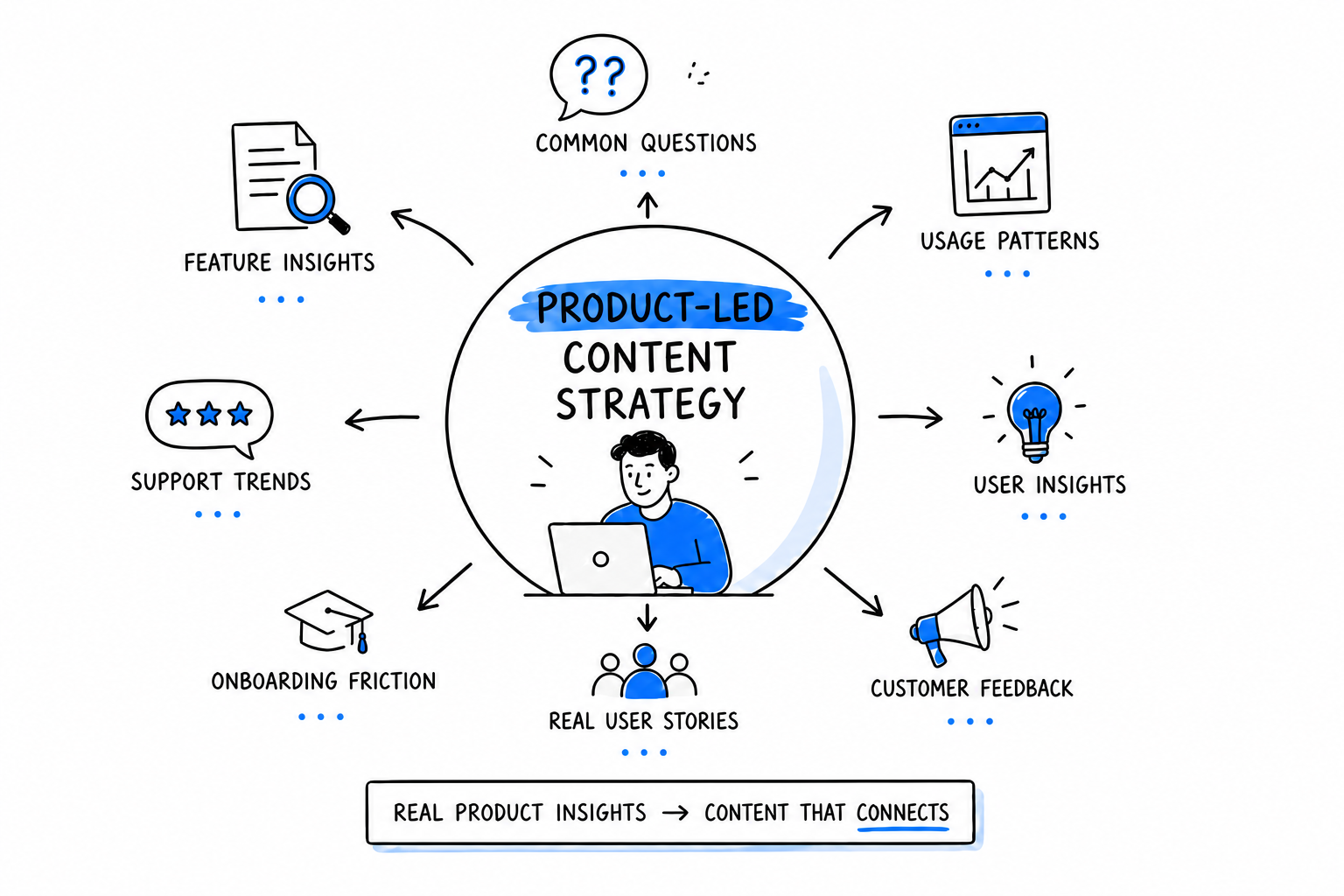
That usually means looking at what real users are doing, struggling with, asking about, or getting value from.
A common way to plan content is to start outside the business and ask, “What are people searching for?”
That matters, of course. But product-led content adds a stronger question:
What are our users already showing us?
Maybe people keep asking how to automate a workflow. Maybe one feature gets heavy use from power users. Maybe customers get stuck at the same onboarding step. Maybe teams use your product in a way you didn’t expect.
Those are all content opportunities. It gives you topics rooted in reality, instead of just search volume.
You end up creating content that feels more specific, more useful, and much harder for competitors to copy.
Your product is already generating ideas every day. You just need to start paying attention.
Content Decay is what happens when a page that once performed well slowly starts losing traffic, rankings, clicks, or relevance over time.
And, it usually fades quietly.
A blog that used to bring steady visits starts slipping a few positions. A page that is ranked on page one moves lower. Click-through rate drops because the title feels outdated. Competitors publish fresher content and slowly take the space.
That’s content decay.
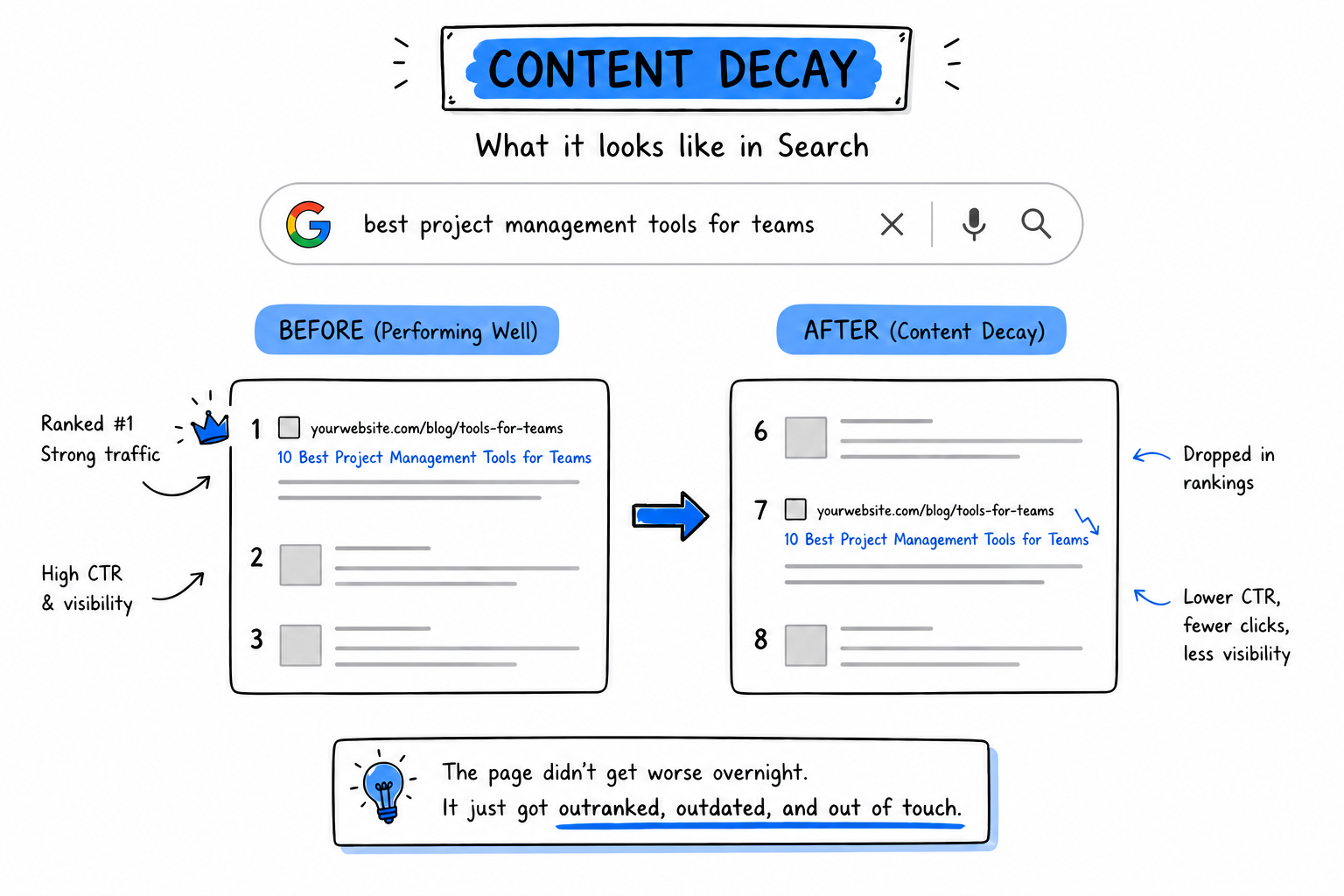
It catches many marketers off guard because the page already “worked once,” so it gets ignored while attention moves to new content.
But search rarely stays still.
User expectations change. New examples emerge. Product screenshots age. Statistics become old. Search results get more competitive. What felt complete two years ago may now feel thin.
Sometimes traffic drops because yesterday’s winning pages were never maintained.
Common signs include:
The good news is this is often fixable.
Refreshing a strong older page can sometimes drive faster results than publishing a brand-new one.
The real lesson here though, is that content is not something you publish once and walk away from..
Angle Framing is the practice of choosing “how” you present an idea, and not just “what” idea you cover.
A lot of marketers spend time finding topics, keywords, and trends. That does matter a lot. But once everyone is talking about the same subjects, the topic alone stops being enough.
What usually makes content stand out is the angle.
Take a common topic like email marketing. You could write a generic piece on best practices, or you could frame it as:
It is the same topic, but from a different lens. That lens changes everything. It shapes curiosity, relevance, and whether someone feels the piece is worth reading.
This is especially useful in crowded markets where readers have already seen the standard version of a topic many times.
Angle Framing helps you move away from saying what everyone else is saying in slightly different words.
It pushes you to ask better questions:
It is important to choose perspectives that make familiar ideas feel fresh again.
Systems Over Goals is the idea that goals can point you in the right direction, but systems are what actually get you there.
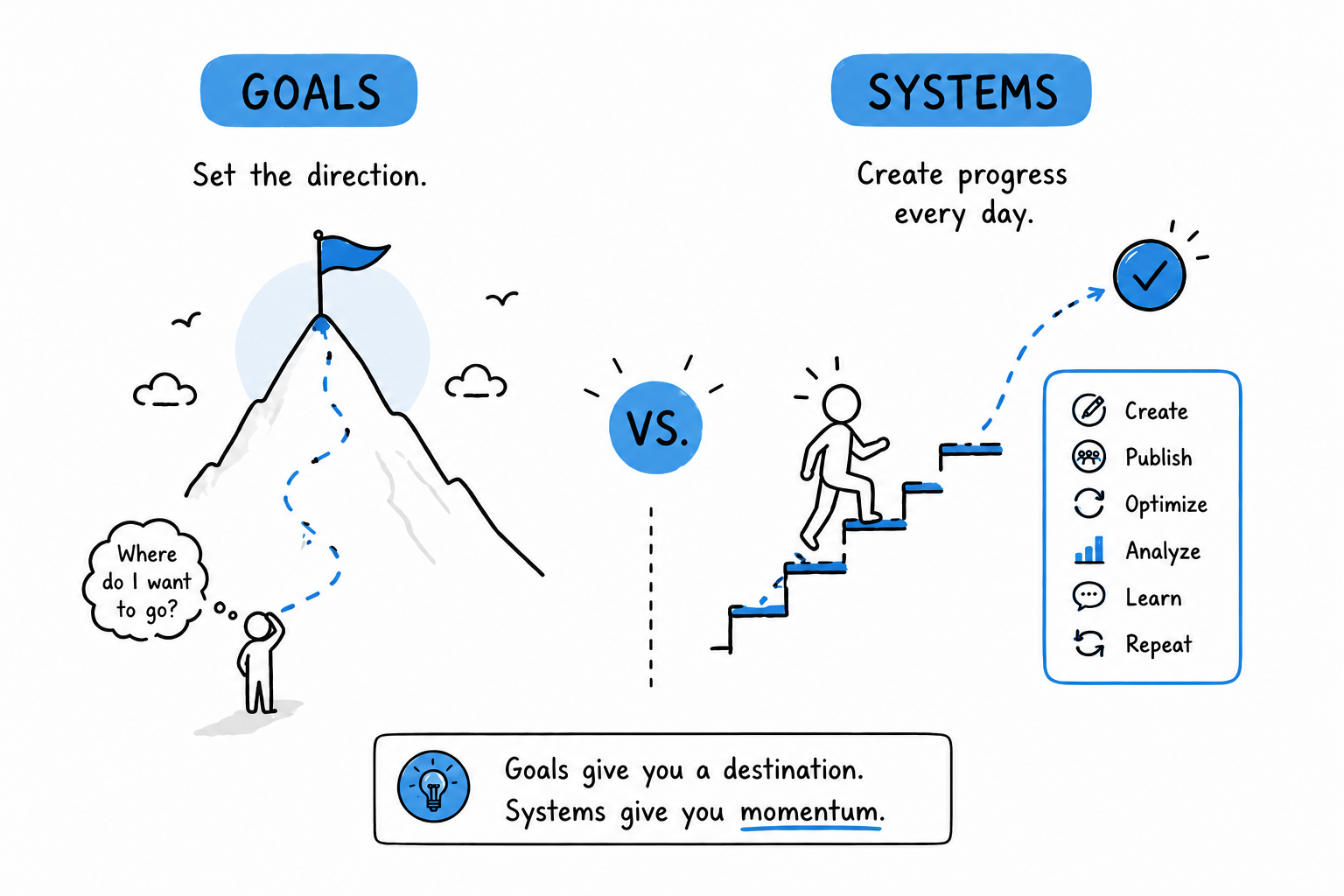
A goal sounds exciting because it gives you something to chase.
There is nothing wrong with goals. They help create direction. But goals alone often lose power once real work begins.
Marketing is full of slow-moving efforts. SEO takes time. Content compounds gradually. Brand trust builds quietly. If your motivation depends only on hitting targets, progress can feel frustrating.
So, systems matter.
A system focuses on repeatable actions you can control:
You’ll see quite wins here. Not through one big quarter or one aggressive target, but through steady actions repeated long enough to compound.
The mindset here is important. Instead of asking, What do we want to hit this quarter? you start asking, What process would naturally produce that outcome over time?
That shift changes everything. Goals can inspire. Systems keep working when inspiration disappears.
If you take one thing from this, let it be this: do not collect frameworks the way people collect buzzwords.
Use them when the work in front of you demands structure.
When a problem feels too broad, use a framework that helps you break it down. When your message feels hard to follow, use one that sharpens communication. When execution keeps stalling, use one that creates repeatable motion.
You also do not need many of them. A small set you understand deeply will be far more useful than twenty you vaguely remember.
And once you begin using them properly, you will notice that the strongest marketers are rarely improvising as much as they appear. Behind clear work is usually clear thinking.